
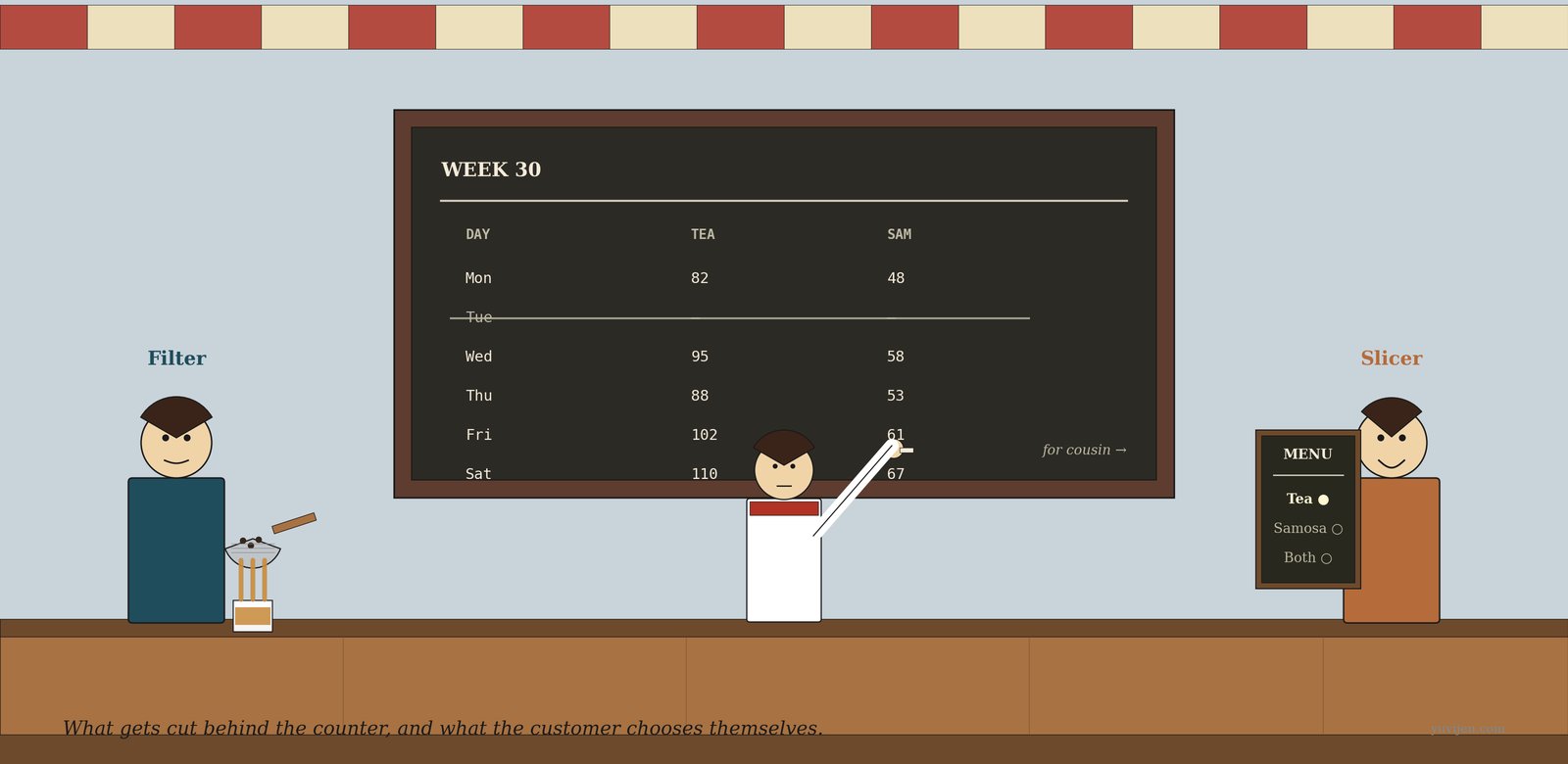
It’s a quiet morning. The kettle is just starting to hiss. The ceiling fan turns slowly above. Reena is at her counter, copying the past week’s numbers from her thirty-day notebook onto the small slate behind her — her cousin is coming this afternoon to look at them.
She keeps stopping mid-line. Some things she wants to rub out before the cousin sees them — the Tuesday the stall was closed, the Sunday page that went smudged. Some things she wants the cousin to be able to flip through himself — just tea, just samosa, both — without Reena rewriting the slate each time. She scratches her head with the chalk.
She mutters, “Cousin will look at this. He will want to see all of it — but not all of it at once. And some things he should not see at all. How do I prepare this?”
The awning rustles.
A woman steps in under the awning — quiet, methodical, holding up a small wire tea strainer above a glass. As tea pours through her strainer, the leaves stay caught in the mesh and only clean amber tea reaches the cup. She sets the strainer down on the counter and says, “I am Filter. I keep what should pass. The rest never reaches the cup.”
A man steps in behind her — cheerful, holding out a small wooden chalkboard menu with three options chalked on it: Tea, Samosa, Both, with little circles next to each. He says, “I am Slicer. I give the customer the menu and let them pick what they see. Same kitchen. Different views.”
Reena looks at them, looks at her slate, and sighs. She asks, “Which one of you do I need?”
They reply in unison: “Both.”
Filter tries first
Filter picks up a damp cloth from the counter. She says, “Tell me what your cousin should never see.”
Reena says, “The Tuesday the stall was closed. There is no data on that line, only an empty space — it will only confuse him. And the Sunday I lost the page.”
Filter nods, wipes the two rows off the slate cleanly, and steps back. The slate now shows only Mon, Wed, Thu, Fri, Sat. The two missing days are not even hinted at — there is no gap, no struck-through line, no apology. They are simply not there.
She says, “The cousin will not ask. He will not even know those days were possible. That is my whole job — quiet, before the audience arrives, invisible. He sees a clean board.”
Reena looks at the slate and says, “Tidy.”
Filter says, “Filter is tidy. The viewer never sees what I removed. He never knows.”
Slicer tries
Slicer steps up next, holding out his menu board. He says, “Now. What does your cousin want to play with? Tea-only? Samosa-only? Tea-and-samosa together?”
He sets the board on the counter next to Reena’s slate. He taps the small circle next to Tea with his chalk and says, “Press one.”
Reena hesitantly fills the circle. As if alive, the slate hides the samosa column. Only the tea numbers are visible now.
Reena asks, “And if I press samosa?”
Slicer says, “Then the slate shows the samosa numbers and hides the tea ones. Same data underneath. Different view. The cousin presses, the slate changes. He never has to ask you for anything.”
Reena smiles and asks, “And if I press both?”
Slicer says, “Then both. He chooses. Live.”
Filter, slightly miffed, says, “He could have done the same with my cloth, you know. Wipe the tea side, show only samosa.”
Slicer says kindly, “Yes — but only if Reena knew in advance which view to make. With me, the cousin chooses. Each time. Without bothering Reena.”
What just happened
Reena sits down on her counter for the first time all morning, pours herself a glass of tea, and asks, “So you both choose what to show. What is the difference?”
Filter says, “I am invisible. Once I wipe something off, the cousin never knows it was there. You are in charge.”
Slicer says, “I am visible. The cousin sees me, presses my buttons, picks his own view. He is in charge.”
Reena says slowly, “So you, Filter, decide for him. And you, Slicer, decide with him.”
Slicer says, “Exactly. He sees me. He never sees her.”
Filter says, “I am the editor. He is the reader.”
The same chat, in a chart
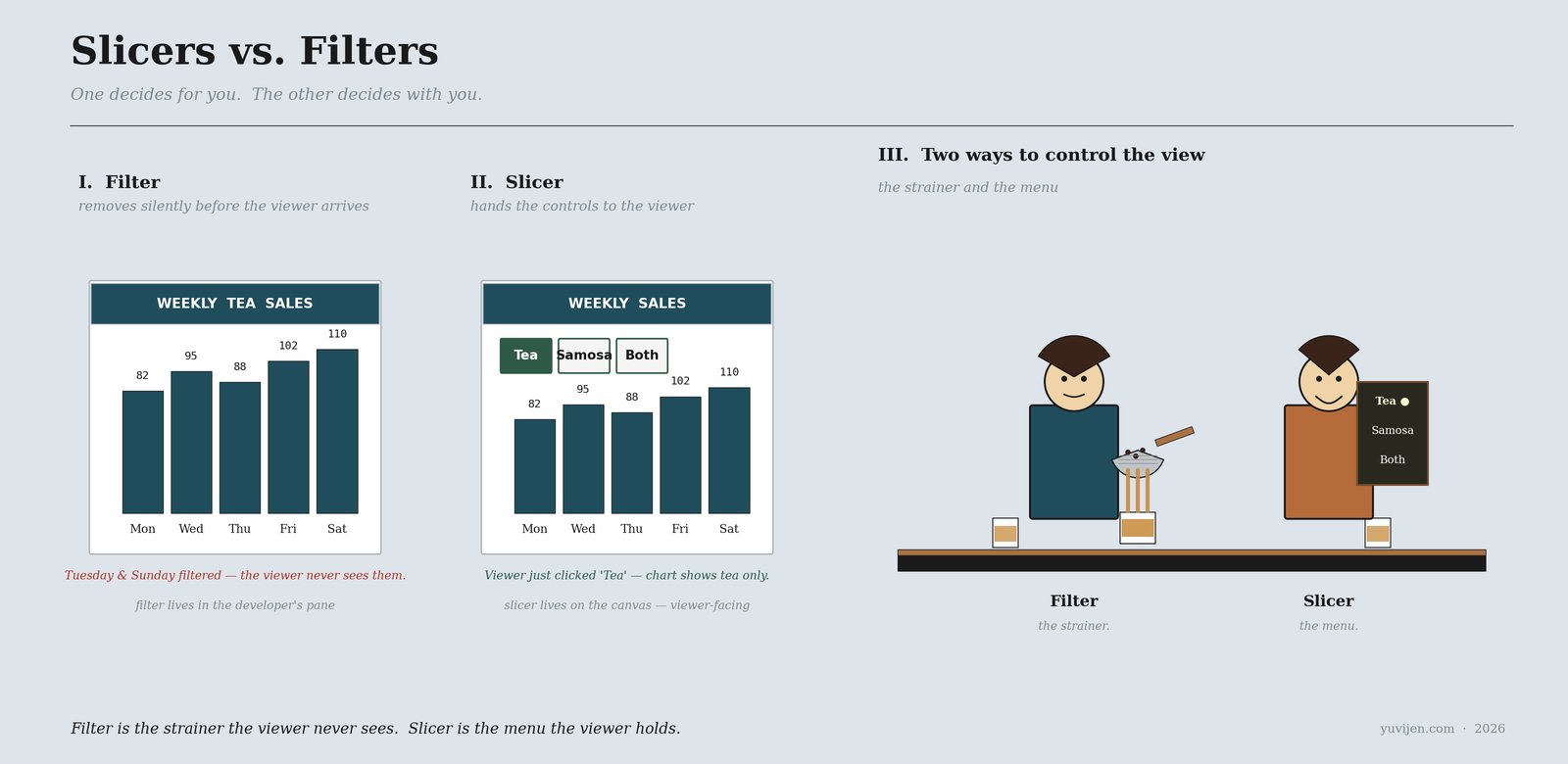
That picture is exactly the same idea, drawn. The first dashboard has a filter applied — Tuesday and Sunday simply do not appear. The second dashboard has a slicer added — three buttons sit at the top of the canvas, and the cousin can press whichever one he wants. Same underlying notebook on both sides. Two different ways of controlling what reaches the viewer.
One last warning before they leave
Slicer steps back from the counter and says, “One thing, Reena. Don’t put a button on my menu for Tuesday’s broken data. The cousin should not have a control for showing rubbish-on-purpose. That decision is hers” — he points at Filter — “not his.”
Filter says, “And don’t use me for things the cousin might genuinely want both ways. If he wants to flip between tea-only and both, that is not my job — that is Slicer’s. Mistake me for him and the cousin will be back tomorrow asking why he cannot see the samosa numbers.”
Reena nods slowly and says, “Hidden if it should never be seen. Buttons if the cousin should choose.”
Filter says, “Hidden. Always.”
Slicer says, “Buttons. Always.”
Quick gut-check
You are building a sales report for your manager. Two requests come in.
- “Hide the rows where the customer’s name is missing — that is bad data.”
- “Let the manager flip between regions — North, South, East, West.”
Which is a filter? Which is a slicer?
The first is a filter — bad data should never reach the manager. The second is a slicer — the manager should pick the region himself, live, without coming back to you.
The bill
The cousin came that afternoon. He saw the clean slate with no Tuesday, pressed a circle on the menu board to see only the samosa numbers, made a small grunt of approval, and left after two glasses of tea. He did not ask about the missing Tuesday. He never knew it had been there.
The fan ticked. The kettle hissed. Filter wiped her strainer clean. Slicer tucked his menu board under his arm.
Use them together. Filter cleans up before the audience walks in. Slicer hands them the menu when they sit down. One is the editor; the other is the waiter. Neither does the other’s job.
For the dashboard-curious
Power BI: Filters live in the Filters pane and have three scopes — visual, page, and report. Slicers are visual elements you drop on the canvas.
Tableau: Filters live on the Filters shelf. Right-click one and pick Show Filter and you have made a slicer (Tableau calls it a quick filter).
Same idea. Different houses.